
3D scanning and reverse engineering: from original to printed part
How we scanned a worn plastic bracket, rebuilt it in CAD and printed a functional replacement — the full reverse engineering workflow from our workshop.
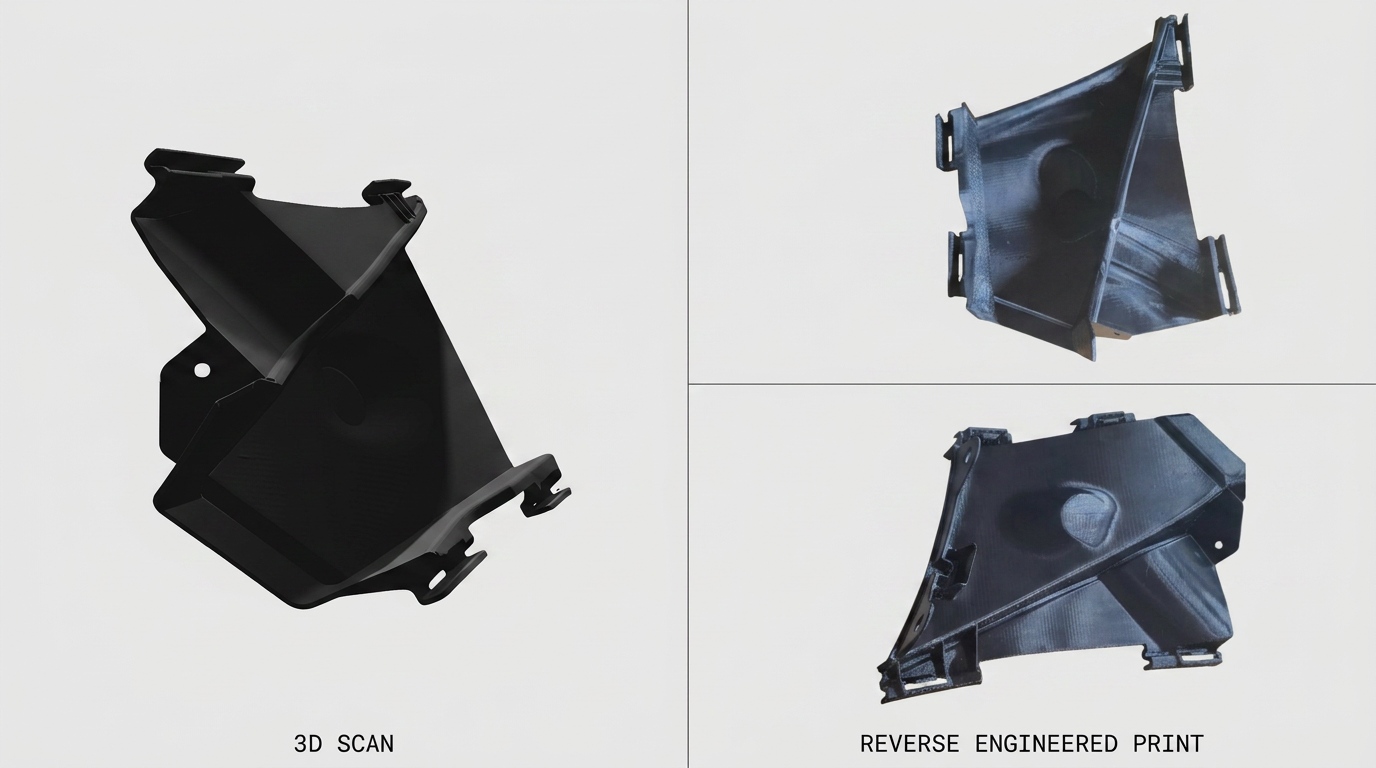
Some parts simply aren't available anymore. The mold is long gone, the supplier is silent, and the original is already cracked in two places. That's where 3D scanning comes in.
SCANNING
Everything starts from geometry. The original — in this case a plastic bracket with a complex organic shape — sits on a rotary table and is captured with structured light. The result is a dense point cloud that we close into a watertight mesh. Accuracy is on the order of 0.05–0.1 mm, more than enough for any non-metrology, functional part.
RECONSTRUCTION
A scanned mesh is not a CAD model. It's dumb geometry with no design intent — no flat faces, no true holes, no ribs you can tweak. The next step is reverse engineering: we extract reference planes, rotation axes and profiles from the mesh and rebuild a parametric model in CAD (Fusion 360 / SolidWorks). Screw holes get exact dimensions, ribs are simplified, wall thicknesses are raised to sensible values for FDM.
CORRECTIONS AND REINFORCEMENTS
Reverse engineering isn't copying. If the original cracked at a specific spot, we add material there, rotate the layer direction, or add an internal rib. If the old plastic was too brittle, we pick a material with more elongation — PETG-CF, PA-CF, PC — depending on the use case. The mesh tells us where the critical points are.
PRINTING
The model is oriented so layer anisotropy works with us — layer lines perpendicular to the load direction. Reinforced materials (carbon-filled nylons and PETG) deliver structural strength close to injection-molded plastics, with a geometric freedom no mold will ever have.
RESULT
Image above: left, the scanned original; right, two printed pieces after reverse engineering. Parts assemble, hold tolerances, and — most importantly — can be reprinted whenever needed. From that point on, the digital model is your spare part on disk.
WHEN IT MAKES SENSE
Reverse engineering pays off when a part is unavailable, expensive, or when you want to iterate on the original — better material, extra hole, adjusted geometry. If you have a case like that, get in touch and we'll take a look together.