
Why dry filament is critical for quality FDM prints
Moisture in filament quietly destroys mechanical properties, surface finish and dimensional accuracy. Here is what actually happens and how to prevent it.
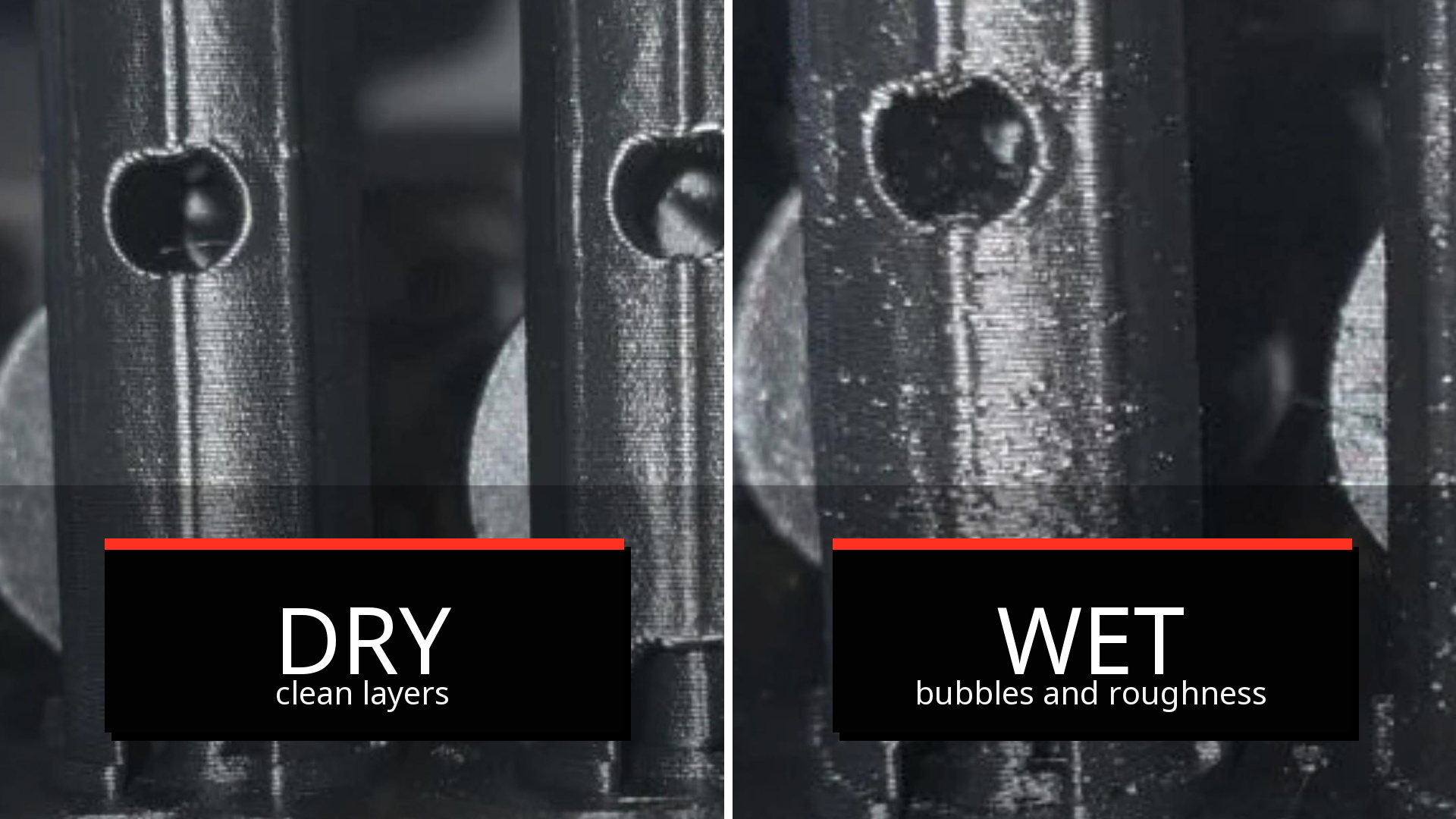
Filament is hygroscopic — it absorbs moisture from the air even when sealed in a bag without fresh desiccant. For FDM this is not a cosmetic detail: moisture changes melt rheology, weakens interlayer bonding, and visibly degrades the surface. The cover image shows the same material, same machine and same slicer profile — left: a freshly opened spool, right: the same spool after a few days in a humid environment.
What physically happens in the nozzle
When filament carrying absorbed water enters the melt zone (200–290 °C depending on the material), water flashes to steam. Steam expands ~1700× vs the liquid phase and:
- causes micro-explosions and audible popping/crackling in the hotend,
- leaves bubbles and craters on the layer surface,
- interrupts continuous flow (under-extrusion, stringing),
- hydrolyses the polymer — for PA, PC, PETG and TPU this permanently shortens the polymer chain and lowers strength in a way drying cannot fully recover.
What moisture actually affects
Mechanical properties. Tensile strength and interlayer adhesion drop 20–60 % for PA-CF, PC and PETG-CF. PLA is milder but measurable (10–20 %). Impact toughness drops even more, because voids act as crack initiators.
Dimensional accuracy. Unstable flow means varying line width, so outer dimensions wander ±0.1–0.3 mm. Holes become oval, threads fail to seat, snap-fits stop clicking.
Surface and appearance. Matte, rough texture, whitish micro-foam marks, stringing between walls, visible flow lines. Colour looks washed out.
Heat resistance and ageing. A hydrolysed polymer cracks earlier under load and tolerates UV/heat worse.
Which materials absorb moisture fastest
From worst to most forgiving:
1. PA (Nylon), PA-CF, PA-GF — unusable within hours, drying is mandatory. 2. TPU — very hygroscopic, bubbly extrusion. 3. PC, PC-CF, PC-ABS — hydrolysis at high temperatures, dramatic strength loss. 4. PETG, PETG-CF — visible popping and stringing after just a few days. 5. ASA, ABS — moderate but measurable surface impact. 6. PLA — most tolerant, but long-term moisture makes it brittle and dull.
How to dry filament correctly
Use an active filament dryer or an oven with precise temperature control. Reference values:
- PLA: 45–50 °C / 4–6 h
- PETG, PETG-CF: 65 °C / 6–8 h
- ASA, ABS: 70 °C / 4–6 h
- PC, PC-CF: 80–90 °C / 6–10 h
- PA, PA-CF: 80–90 °C / 8–12 h (very wet spools up to 24 h)
- TPU: 50–55 °C / 6–8 h
For demanding materials (PA-CF, PC) we recommend printing directly from the dryer — the spool stays at 55–70 °C during the whole print.
Storage between prints
- Vacuum bags with fresh indicating silica gel (blue/orange type).
- Dry cabinets with active dehumidification for technical materials.
- Never leave spools out overnight, especially PA and TPU.
When the print is already going wrong
If you hear popping, see bubbles or stringing — stop the print, dry the spool, then continue. Pushing through with a "slightly wet" material means delivering a part that looks printed but is mechanically far below the datasheet.
For functional parts this is not an option — that is why at 3D4U every technical spool is checked for moisture before printing and, when needed, actively dried. The difference is visible on the part, and more importantly — measurable in testing.