
PETG-CF: carbon fiber reinforced PETG for stiffer FDM prints
PETG-CF combines the ease of printing PETG with the rigidity of carbon fibers. Benefits, drawbacks and how carbon content (5% vs 20%) fundamentally changes part behavior.
What PETG-CF is
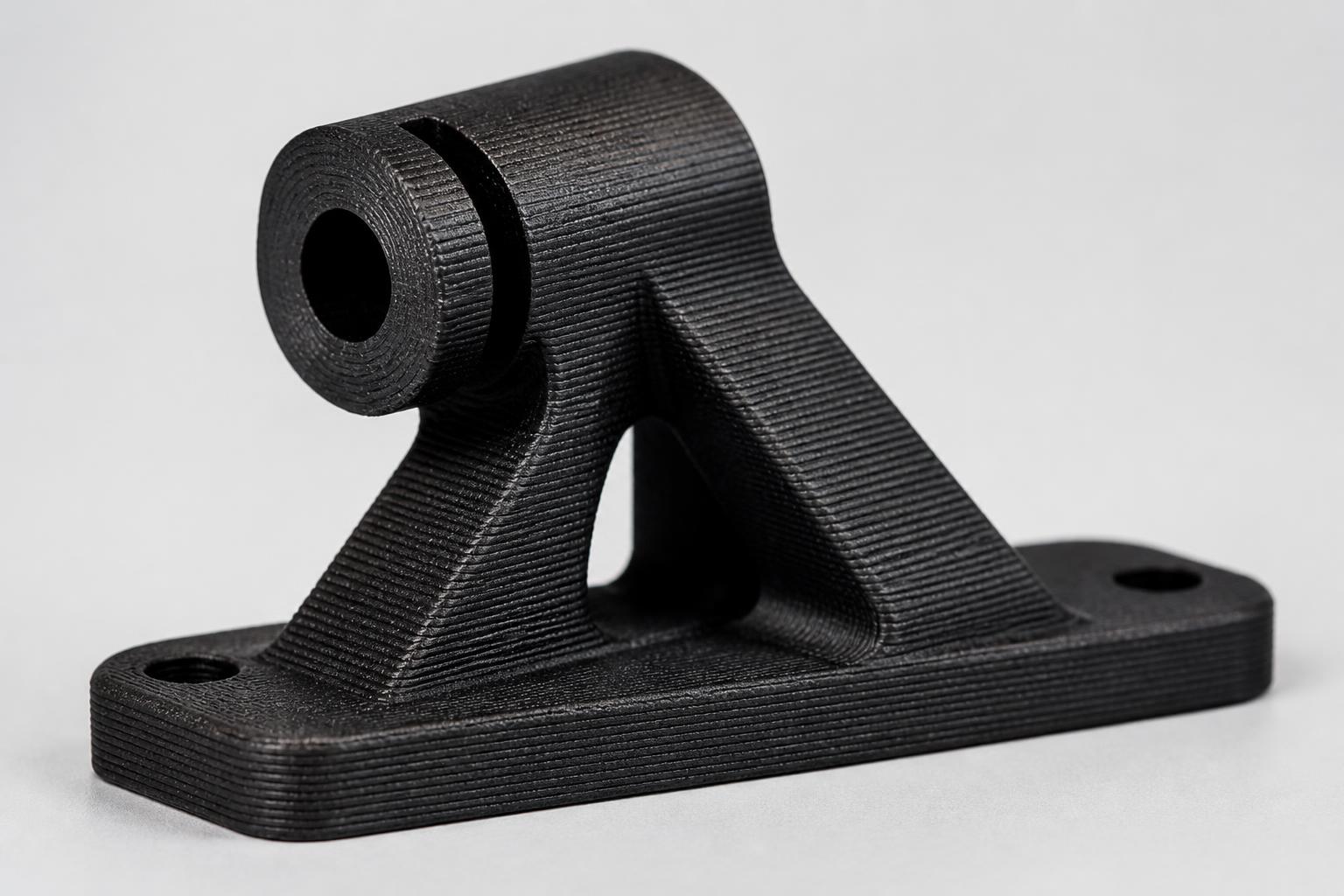
PETG-CF is a composite filament made by adding finely milled carbon fibers (typically 5% to 20% by mass) to standard PETG. During extrusion, the fibers align in the direction of material flow, which gives the printed part significantly higher stiffness, dimensional stability and a professional matte finish without the glossy look typical of pure PETG.
The goal was never to replace PETG — it was to fix its biggest weaknesses: tendency to creep under sustained load, pronounced shrinkage when cooling large flat parts, and susceptibility to deformation at higher temperatures.
Advantages of PETG-CF
- Higher stiffness and less deformation — Carbon fibers act as micro-reinforcement inside the polymer. The elastic modulus increases by 40% to 100% compared to pure PETG, depending on fiber content. Parts flex less under load, and large flat pieces warp noticeably less during cooling.
- Dimensional stability — Carbon fibers reduce the thermal shrinkage of the material during cooling. For functional parts that need to fit — enclosures, brackets, jigs — this means tighter tolerances and less post-processing.
- Higher service temperature — PETG-CF handles sustained load at higher temperatures (up to around 75°C before significant softening) compared to pure PETG. This makes it suitable for parts near motors, electronic enclosures under load, or pieces exposed to summer sun.
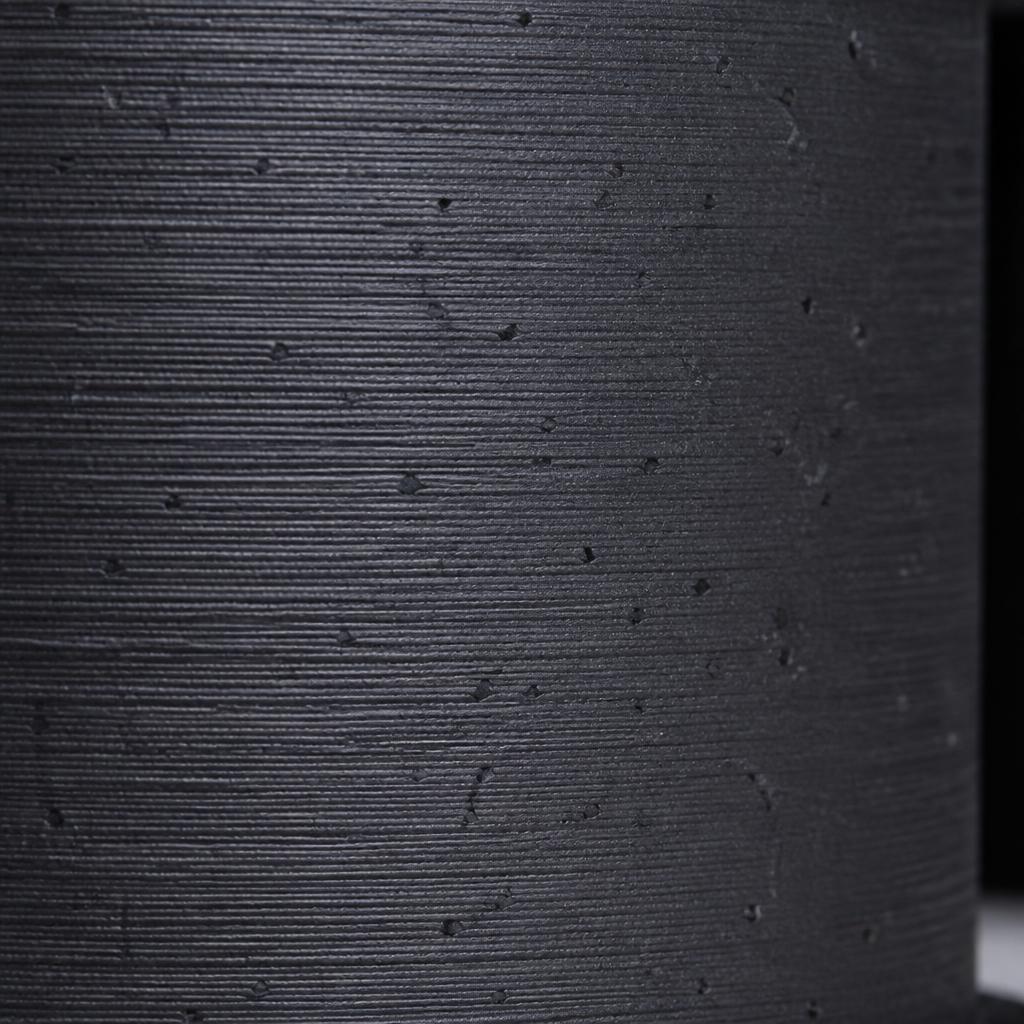
- Professional aesthetic — The matte, dark, subtly textured surface hides layer lines and looks noticeably more "engineered" than glossy PETG. For presentation prototypes and visible parts, this is often the deciding factor.
Drawbacks of PETG-CF
- Nozzle wear — Carbon fibers are abrasive. A standard brass nozzle will wear out within a few dozen hours to the point where the diameter is no longer accurate. For PETG-CF we always use hardened steel nozzles or nozzles with a ruby/diamond insert.
- Brittleness and reduced elongation — Fibers increase stiffness but reduce elasticity. Pure PETG can bend before it breaks — PETG-CF snaps more abruptly, with less elongation at break. For parts that need to absorb impact or flex elastically, pure PETG or PETG-HF remains the better choice.
- Weaker interlayer bonding — Fibers align nicely in the XY plane, but there is no reinforcement between layers (Z axis). Prints are anisotropic — strong along the fiber direction, significantly weaker perpendicular to the layers. Critical parts should be oriented so that load runs along the layers, not through them.
- Moisture sensitivity — Like PETG, PETG-CF absorbs moisture from the air — and the carbon fibers make it even faster. Wet filament produces bubbling, poor layer adhesion and a hazy surface. Drying before printing (65°C, 4-6 hours) is mandatory, and storing in an airtight box with desiccant is not a suggestion but a rule.
Carbon fiber content — 5% vs 20%
This is the difference most buyers overlook. Different manufacturers use very different fiber ratios, and the behavior differences are significant.
Low content (5% to 10%)
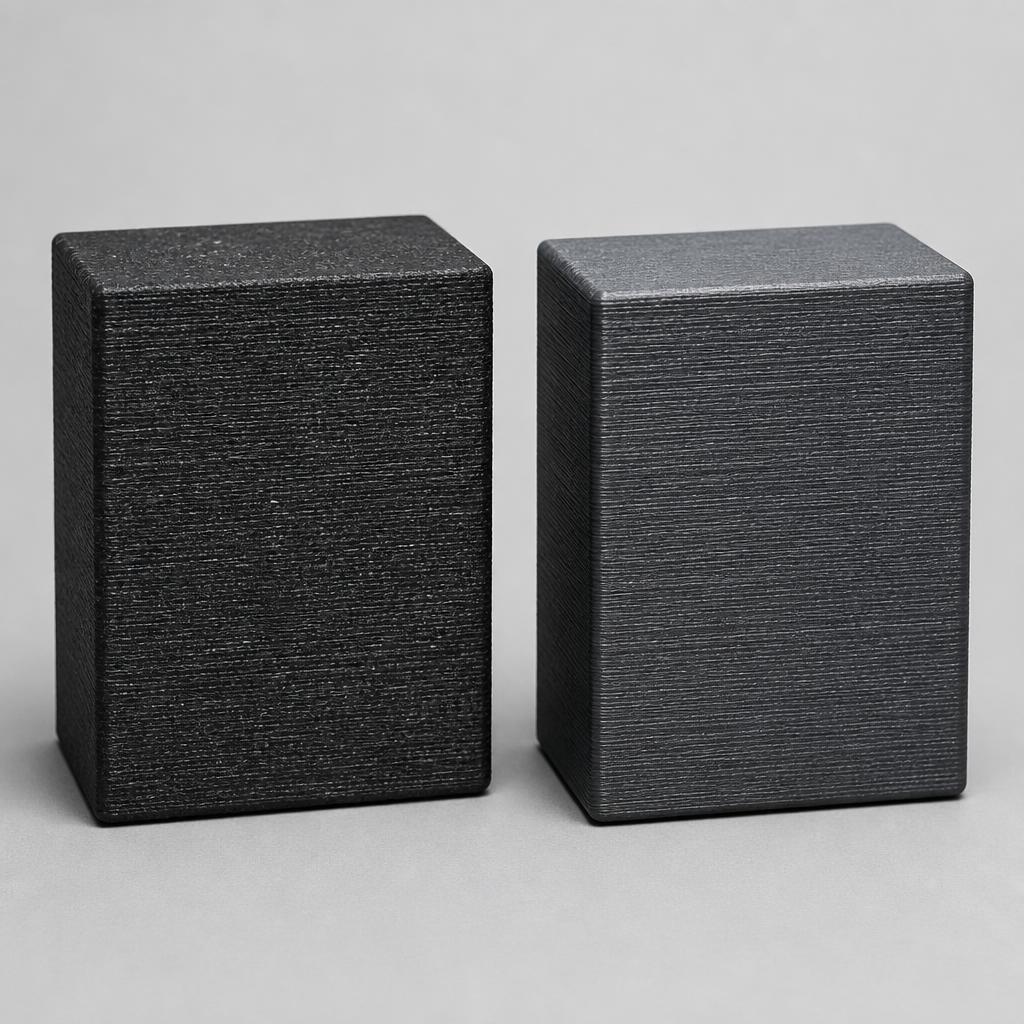
Filaments with lower carbon content behave closer to pure PETG: more flexible, better elongation, better interlayer bonding. Printing is easier, they are less picky about parameters, and nozzle wear is slower. Aesthetically they are "semi-matte" — texture is visible but slightly smoother and glossier.
Ideal for: presentation prototypes, parts that need slight flexibility, pieces where appearance matters but mechanical properties are secondary.
High content (15% to 20%)
Filaments with high carbon content are significantly stiffer, more dimensionally stable and more heat resistant, but at the same time more brittle and more sensitive to print parameters. Nozzle wear is very fast, and weak interlayer bonding becomes a serious limitation unless parts are oriented cleverly.
Ideal for: functional brackets, jigs and fixtures, parts that must hold tolerance, enclosures exposed to heat.
How manufacturers differ
Beyond the fiber percentage itself, manufacturers also differ in:
- Fiber length — shorter fibers (0.1-0.2 mm) flow more easily through the nozzle but give less mechanical benefit. Longer fibers (0.4-0.8 mm) significantly boost strength but clog nozzles more often.
- Quality of the base PETG — cheap PETG as a base produces a composite that is more brittle than it should be, regardless of the carbon.
- Compatibilizers — additives that help fibers "bond" better to the PETG matrix. Without them, fibers behave as cracks in the material instead of as reinforcement.
Print parameters
In practice we use for PETG-CF:
- Nozzle temperature: 240°C to 260°C (higher than pure PETG because fibers increase viscosity)
- Bed temperature: 70°C to 85°C
- Print speed: 40-60 mm/s (slower than PETG — longer dwell in the hot zone helps melting)
- Nozzle: hardened steel, minimum 0.4 mm (0.6 mm is safer)
- Filament drying: 65°C, 4-6 hours before printing
- Enclosed chamber: preferred, reduces warping on large parts
When to choose PETG-CF
PETG-CF makes sense when you need a combination of:
- functional stiffness greater than pure PETG
- heat resistance up to 75°C
- professional matte appearance without post-processing
- easier printing than nylon or PA-CF (no actively heated chamber needed)
If you need more strength and temperature — go with PA6-CF or similar nylon composites. If you need flexibility and impact strength — pure PETG remains the better choice. If you need the best dimensional accuracy and aesthetics at a moderate price — PETG-CF is the sweet spot.
Need advice on material selection for a specific project? Get in touch — we will go through the requirements together and recommend the optimal filament for your case.