
Safety in a small FDM production shop: masks, air purification and fire detection
Everything a small FDM production shop needs to keep the production manager safe — particulate respirators, air purifiers and ventilation, and smoke and fire detection systems.
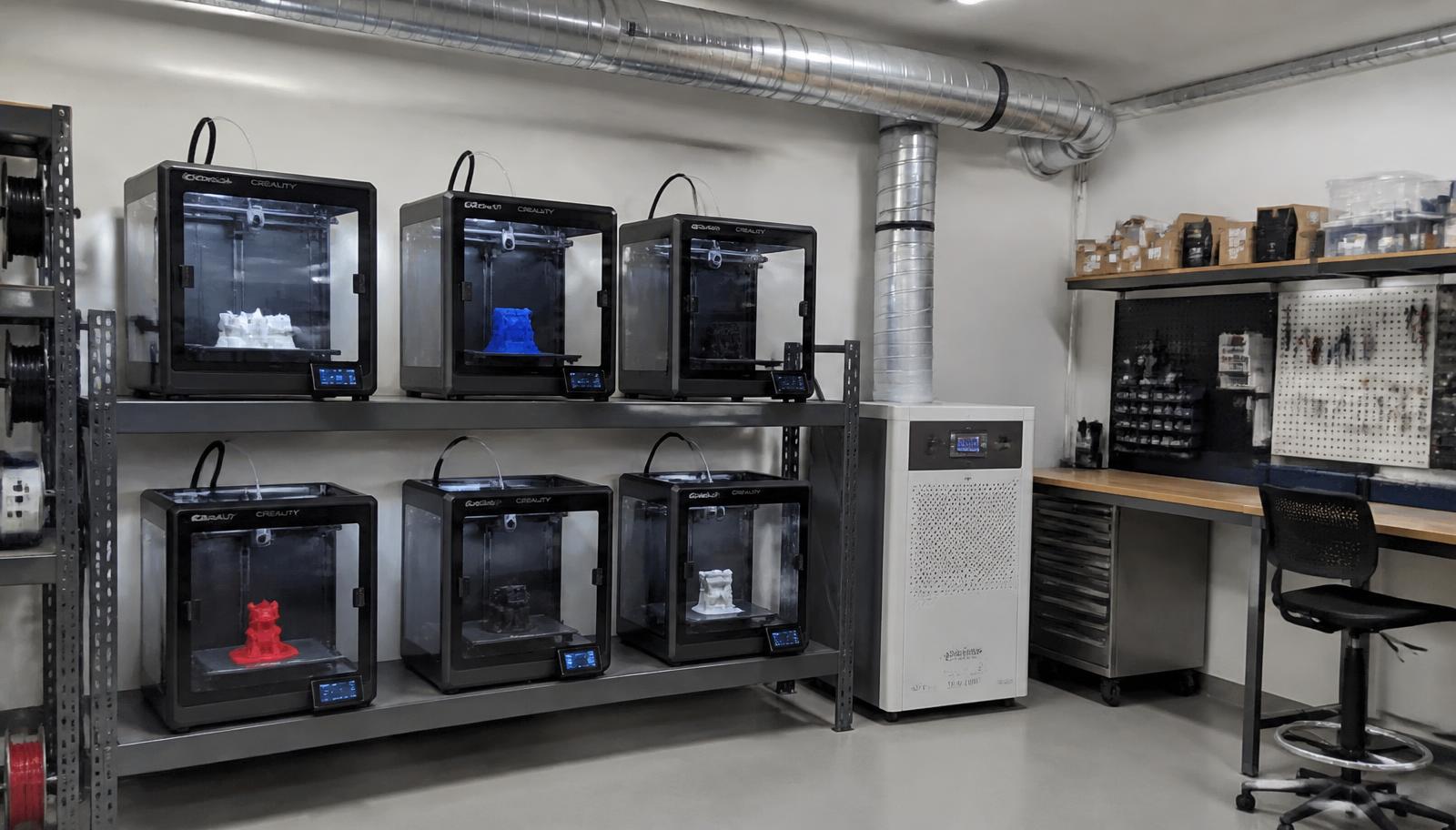
A small FDM shop running five, ten or twenty printers 24/7 is not the same thing as one printer in the corner of a home office. As machines and print hours multiply, so do three risks: inhaling ultrafine particles and volatile organic compounds (VOCs), thermal overload of electronics and heaters, and operator fatigue from spending all day in the same room. This is a practical list of what you actually need to keep the production manager protected — no theatre, but no skipped steps either.
What FDM printing actually emits
Every hot extruder emits two groups of contaminants. First, ultrafine particles (UFP) below 100 nanometres, which reach deep into the lungs because the nose and throat do not filter them. Second, volatile organic compounds, depending on the material: PLA is the mildest (mostly lactide and a faint smell), PETG is moderate, while ABS and ASA emit styrene, and polyamides (PA6, PA6-CF) and carbon-fibre composites add both odour and filler particles.
- PLA: lowest VOC emission, but still a measurable amount of UFP at high speeds and temperatures.
- PETG: moderate emission, usually no strong smell, but plenty of invisible UFP.
- ABS / ASA: the most problematic because of styrene — needs an enclosed printer and exhaust, not just a filter.
- PA6, PA6-CF, PETG-CF: filler particles and micro-dust during sanding and finishing — here a respirator is a rule, not an option.
Particulate respirators
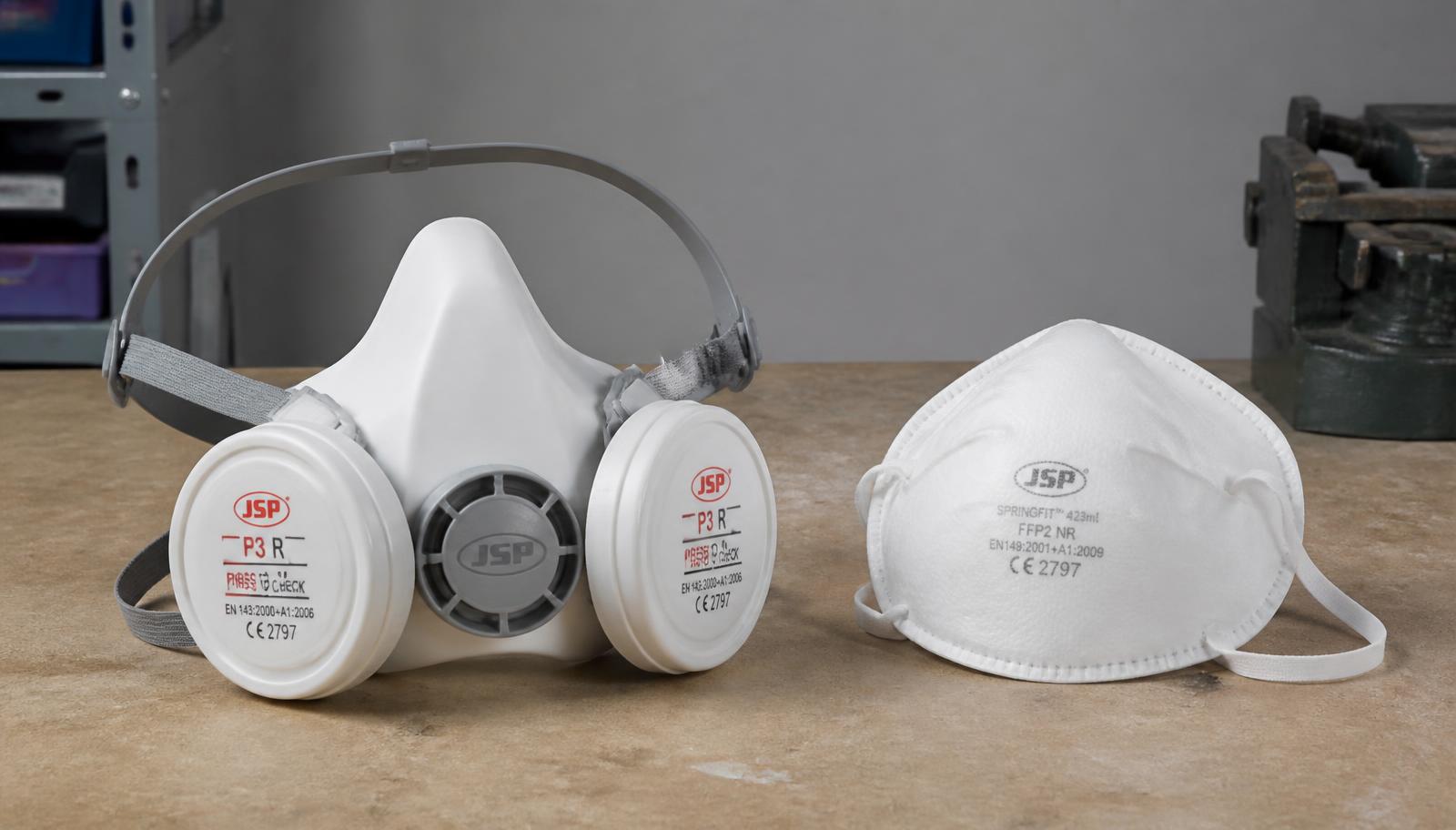
A surgical mask does not protect against ultrafine particles — it stops droplets, not aerosol. A production shop uses respirators classified to EN 149 (disposable) or EN 143 (replaceable filters).
- FFP2 (P2): filters roughly 94% of particles. Enough for short entries into the room, removing parts and routine printer service.
- FFP3 (P3): filters roughly 99% of particles. Mandatory for sanding, sawing and drilling printed parts, especially carbon-fibre composites.
- Half mask with replaceable filters: cheaper long term and seals better; a P3 filter plus an A1 organic-vapour cartridge covers ABS/ASA as well as painting and gluing.
- Exhalation valve: the detail that decides whether the mask is worn longer than 20 minutes — without it, it fogs up and comes off.
The mask has to seal: clean-shaven or short stubble, glasses must not lift the upper edge, and after every fitting do a quick palm-over-filter seal check. Disposable masks are not dried out and reused the next day.
Air purifiers and ventilation
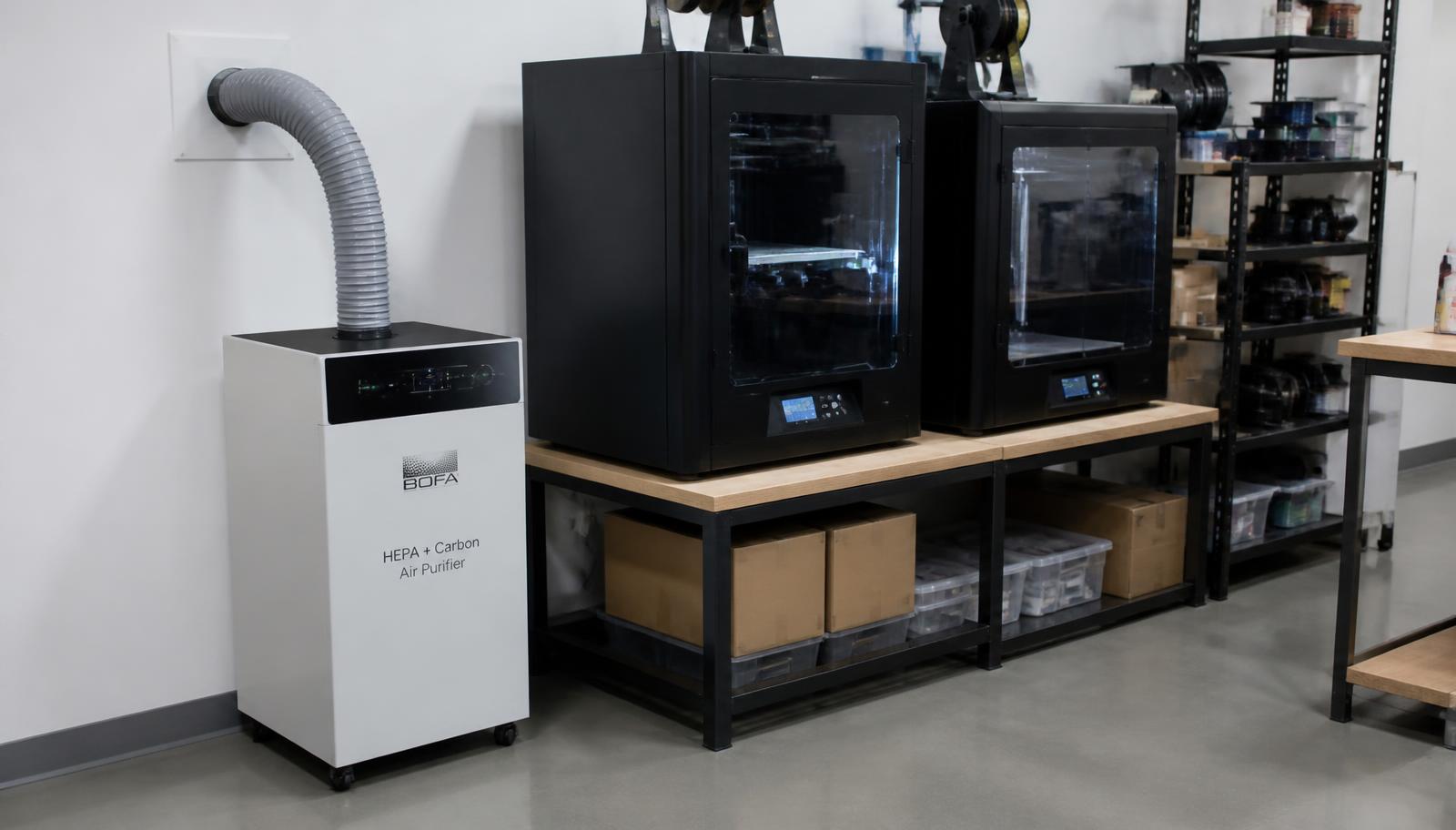
The order is always the same: contain the source, exhaust the air outside, and only then filter what is left. A filter without ventilation is a compromise; ventilation without an enclosed printer wastes heat and ruins ABS print quality.
- Enclosed printer: the enclosure keeps 80-90% of emissions at the source and stabilises chamber temperature. The single biggest safety gain per euro spent.
- Source capture exhaust: a short flexible duct from the printer or chamber to a wall vent with a small in-line fan. Practically mandatory for ABS, ASA and polyamides.
- HEPA H13/H14 + activated carbon: HEPA catches particles, carbon binds VOCs. One without the other solves half the problem.
- Capacity (CADR): aim for 5-8 air changes per hour. For a 25 m² room at 2.7 m height that is roughly 340-540 m³/h.
- Fresh air supply: if you only extract air, the room goes negative and pulls air from adjacent spaces. Plan an intake grille or a filtered window opening.
- Heat recovery in winter: an HRV unit keeps the heating bill sane and the room ventilated without draughts across the printers.
Filters are replaced on a schedule, not when you remember: pre-filter monthly, carbon every 3-6 months, HEPA every 12-18 months under continuous operation. A cheap PM2.5 and VOC meter on the bench is the best 40-euro investment in the shop — otherwise you have no idea whether the system works.
Fire detection and fire protection
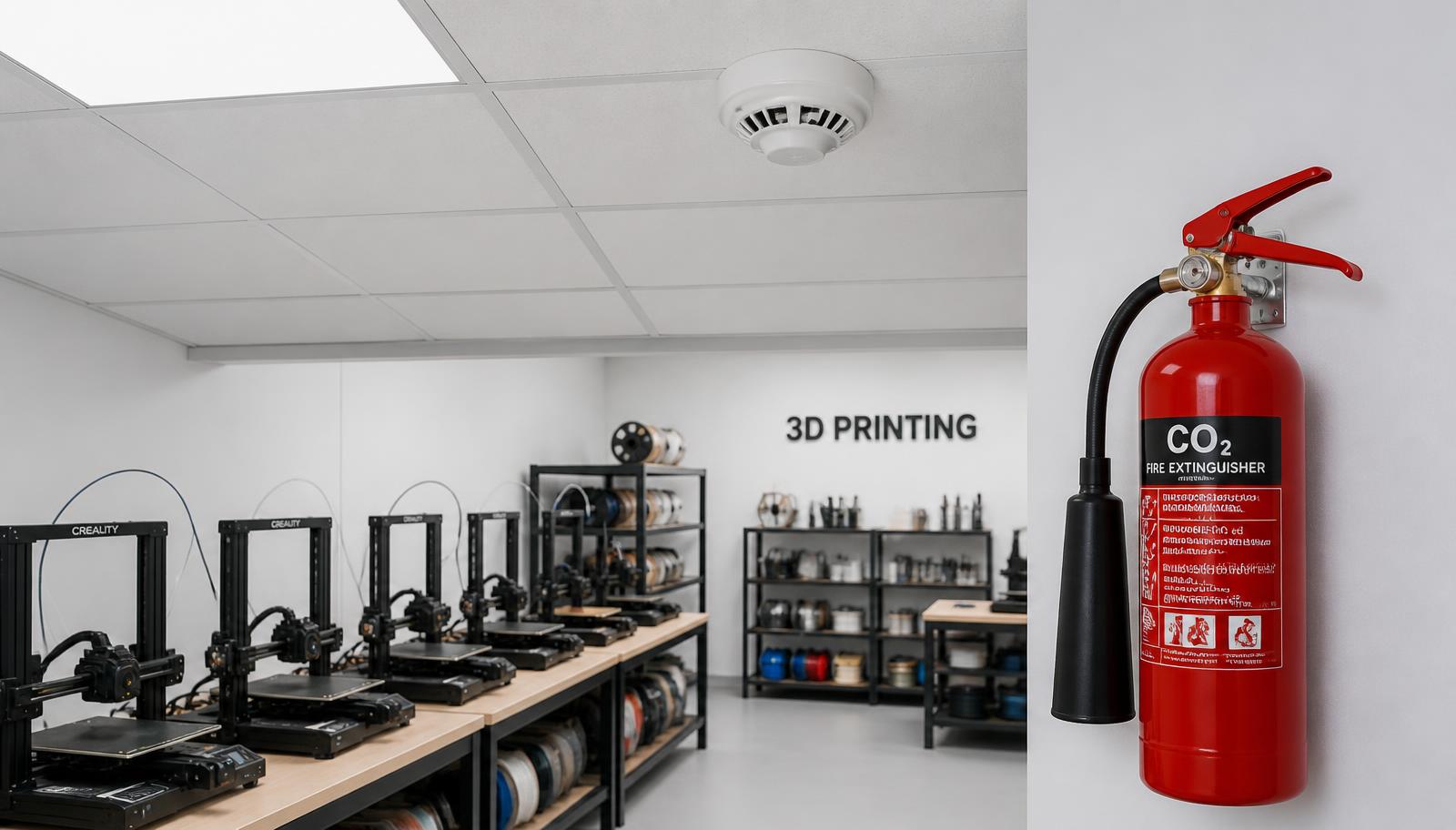
Unattended printers are the biggest real risk in the shop: heater cartridges, MOSFETs, heated-bed connectors and filament dust build-up. The system has to react when nobody is in the room.
- Optical smoke detector: minimum one per room, on the ceiling, not directly above a printer where rising hot air bypasses it.
- Heat detector: a useful complement in dusty rooms where optical units produce false alarms.
- Connected system (Wi-Fi / GSM alerting): the alarm must reach the production manager''s phone, otherwise at 3 a.m. nobody knows something went wrong.
- Fire extinguisher: CO2 or ABC powder near the exit, not at the back of the room. CO2 will not destroy the electronics of neighbouring machines.
- Automatic power cut: a relay or smart plug that kills a whole printer row on a detector signal or over-temperature.
- Fire-resistant surface and spacing: printers do not sit on bare plywood; use steel shelving, mineral wool or a fibre-cement board underneath.
- Thermal checks: an occasional thermal camera or cheap IR thermometer pass over bed connectors and PSU terminals finds problems before they char.
Layout and the production manager''s routine
- Zoning: printers, finishing (sanding, cutting) and the computer desk in three separate zones. Sanding dust must not land on prints or in linear bearings.
- Extraction at the bench: a small extractor or hood above the sanding station removes 90% of operator exposure.
- Gloves and eye protection: nitrile gloves for gluing and painting, safety glasses for cutting and support removal.
- Wet cleaning: mop the floor, never sweep — sweeping puts the particles straight back into the air.
- Breaks outside the room: coffee and breaks away from the machines, never next to a printer running ASA.
- Records: a short paper or digital log of filter changes, detector tests and printer service. Without a log, it gets skipped.
Minimum viable safety set
Starting from zero on a limited budget, this order gives the best effect per euro:
- 1. Enclosed printers or an improvised enclosure with a door.
- 2. Exhaust to the outside with a small fan and a wall vent.
- 3. FFP3 respirators plus FFP2 for routine work, kept in stock.
- 4. HEPA + carbon purifier sized to the room volume.
- 5. Connected smoke detectors with phone alerting.
- 6. CO2 extinguisher and fire-resistant surfaces under the machines.
- 7. PM2.5/VOC meter to verify that all of the above actually works.
In the 3D4U shop this approach is not bureaucracy — it is the condition that lets us print ABS, ASA, PA6-CF and PETG-CF all day without headaches, without odour in the room and without risk to the person running production. Safety is part of the process, not an afterthought.